The short answer
A useful LinearZ plan connects your concern to the areas and settings proposed, the limits of treatment and the total cost. A shot count on its own cannot tell you whether that plan suits you.
Start with what you want to change
A softer-looking jawline, a hollow cheek and a change in skin texture can appear together, but they are different concerns. Before choosing a device, describe what you notice and what you hope would change. Pointing to an area is often more useful than asking for the largest package.
At Glassy, treatment is performed by a board-certified dermatologist, and the medical team consults and treats in English. Your history and an examination help frame the discussion. Bring information about previous fillers, threads, energy treatments and any reaction you experienced.
A non-surgical treatment has limits. If substantial lifting, immediate change or replacement of lost volume is your main goal, ask what this particular treatment can realistically address and whether a different approach deserves consideration.
Linear and Dot describe delivery, not a ranking
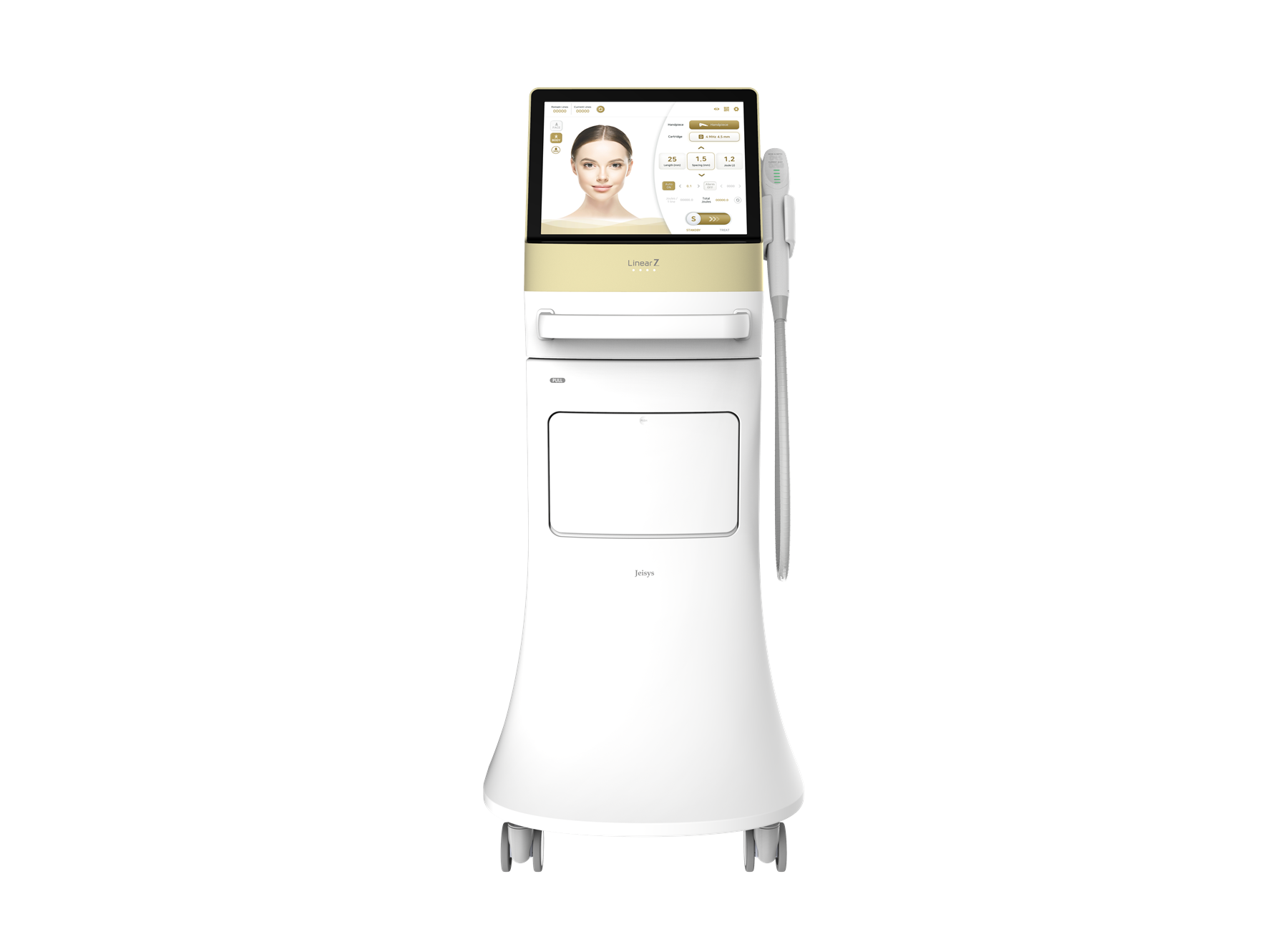
LinearZ uses focused ultrasound in two patterns: Dot delivers separated focal points, while Linear delivers energy along a line. At Glassy, both modes are used. Your dermatologist selects the mode, cartridge, available depth and energy by area rather than applying the same setting across the face.
Skin type, tissue thickness, fat distribution, treatment goals and pain sensitivity all contribute to that plan. A catalogue depth is a distance below the surface; it does not identify the same anatomical layer in every person. Settings must follow the actual cartridge and treatment instructions.
For example, fullness beneath the chin and a hollow lateral cheek may exist in the same face. Those areas require separate decisions: a contour goal under the chin does not justify using the same volume-reducing intent on an already hollow cheek. Some areas may need a different approach or no ultrasound treatment.
Source: Jeisys Medical · LinearZ product, modes and cartridge specifications.
Four cartridge families, selected for the area
Glassy uses all four cartridge families shown on the manufacturer’s product page: BASIC, ESSENTIAL, CORE and CONTOUR. This includes face and body options. It does not mean that all four, every depth or both modes are appropriate for every patient.
The manufacturer’s Specifications table lists BASIC at 2.0/3.0 mm, ESSENTIAL at 1.5/2.0/3.0 mm, CORE at 4.5/6.0 mm and CONTOUR at 9.0/11.0/13.0 mm, with Dot and Linear modes. A deeper body option is not a standard setting for the face.
The same page’s graphic lists additional depth steps and says 0.5-mm adjustment belongs to the ACCU series. Because those details differ from its Specifications table, do not assume continuous adjustment or an exact cartridge version from an illustration. The clinician checks the actual available cartridge before selecting a depth.
At Glassy, BASIC, ESSENTIAL and CORE are selected for facial skin, fat and fascial-layer planning, while CONTOUR is selected for body-fat treatment planning. The appropriate cartridge, tissue target and depth are assessed individually.
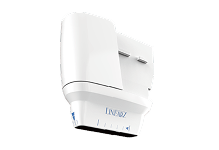
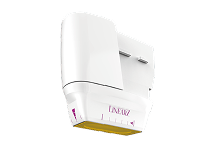
Manufacturer cartridge images © Jeisys Medical. Nominal depths follow the Specifications table; options depend on the actual cartridge version. Body depths are not a standard face protocol.
Source: Jeisys Medical · LinearZ product, modes and cartridge specifications. © Jeisys Medical. Device illustrations explain a concept and are not patient results.
Source: Jeisys Medical · LinearZ product, modes and cartridge specifications.
What a shot count leaves out
Glassy offers 300-shot, 400-shot and 500-shot options. The appropriate count depends on the areas and coverage agreed with your dermatologist. These are shot-count choices, not fixed promises that a particular facial area will receive a particular number.
A shot count cannot show how energy is distributed, which delivery mode is selected, which depth is appropriate, or where volume should be preserved. More shots, greater depth or higher energy do not automatically make the plan better.
Ask which areas will be covered, what is being targeted and which areas should be treated cautiously or avoided. Body treatment requires its own coverage and price confirmation; the existence of body cartridges does not mean a facial shot option includes every body area.
Agree how and when to review change
At Glassy, we generally recommend a course of at least three sessions, spaced 4–8 weeks apart. This is our clinic’s treatment approach, not a universal research-proven schedule. Your dermatologist adjusts the plan to your response, tolerance and availability.
An immediate appearance is not the same thing as a settled outcome. Ask your dermatologist what change is being sought, when it should be reviewed and what would justify another session. Do not treat a fixed package schedule as a guarantee of benefit.
Experimental research using LinearZ has examined collagen and elastin responses in laboratory and animal models. It helps explain a possible biological mechanism, but it cannot tell you the exact improvement, timing or duration you will experience.
A 2026 case series enrolled 38 Korean adults, with 32 completing follow-up, and reported contour changes assessed at 4 and 12 weeks. Without a sham control and with only short follow-up, it does not establish long-term benefit or a standard repeat-treatment schedule.
If photographs are used to compare change, record dates, treatment areas, session number and any combined procedures. Similar lighting and position make the comparison more useful; a combined-treatment photograph cannot isolate the contribution of LinearZ.
Source: Cells, 2023 · HIFU, collagen and elastin in experimental models · Plastic and Reconstructive Surgery Global Open, 2026 · Dual-mode LinearZ case series.
Ask for the whole quote
Glassy’s 300-shot option is ₩390,000, the 400-shot option ₩490,000 and the 500-shot option ₩590,000, all excluding 10% VAT. The totals after VAT are ₩429,000, ₩539,000 and ₩649,000 respectively. These are single-session face options. The body option is 1,000 shots for ₩990,000 excluding VAT (₩1,089,000 including VAT). Face options include soothing care and a mask; body includes soothing ointment application only, without numbing cream, a mask or a soothing-care session. Body appointment timing is confirmed individually. No area-specific package or three-session discount has been set here.
All three prices include post-treatment soothing care and a soothing mask. Optional numbing cream has no additional charge. Confirm treatment areas and any separate combined treatment in your quote. Payment is in Korean won.
A recommended treatment course is separate from a prepaid package. If you are visiting Seoul briefly, ask what can realistically be planned within your dates and how the remaining sessions or follow-up would be handled.
Sources and how to read them
- Jeisys Medical · LinearZ product, modes and cartridge specifications
Official product description. Nominal depths below follow its Specifications table; its depth graphic differs, and 0.5-mm steps are described as ACCU-series only. Exact cartridge options need model-specific verification.
- Plastic and Reconstructive Surgery Global Open, 2026 · Dual-mode LinearZ case series
38 Korean adults enrolled; 32 completed 12-week follow-up. Single-arm case series without a sham control; hollow-prone faces were excluded. Longer-term durability remains uncertain.
- Cells, 2023 · HIFU, collagen and elastin in experimental models
Laboratory and animal research using LinearZ; it does not establish a person’s result, treatment interval or duration of benefit.
- US FDA · Non-invasive body contouring technologies, ultrasound section
General ultrasound safety context, not a LinearZ-specific approval or a facial treatment protocol.
- Sofwave · Official safety information
Sofwave-specific indications, precautions and adverse events; these are not interchangeable with LinearZ instructions.
- Sofwave · Ultrasound technology overview
Manufacturer overview describing mid-dermal ultrasound; it does not establish superiority over another device.
- Ultherapy · Official technology overview
Manufacturer information about real-time ultrasound imaging; this is a technical distinction, not a head-to-head outcome trial.
- Medical Lasers, 2025 · Two-depth versus three-depth LinearZ split-face study
22 Korean women; follow-up to 16 weeks. Between-protocol lifting differences were not statistically significant. Funded by Jeisys and a Korean health research grant; no Ultherapy arm.
- Jung et al., 2016 · Evaluator-blinded split-face comparison of two HIFU devices
20 Korean patients; abstract describes similar efficacy. Device names are not in the abstract available here. Do not identify it as a LinearZ–Ultherapy trial without verifying full methods.
- CLASSYS · ULTRAFORMER MPT
Official manufacturer identification. Ultraformer is a CLASSYS platform, distinct from Jeisys LinearZ.
- Jeisys Medical · ULTRAcel, LinearFirm and LinearZ device history
Manufacturer generation history; predecessor studies do not automatically establish outcomes for the current system.
Manufacturer descriptions, research and clinic practices describe different evidence. This clinic-review edition does not claim a clinical review endorsement.