The short answer
LinearZ offers Dot and Linear delivery with cartridge-dependent depth choices. Ultherapy offers real-time ultrasound imaging. Those features describe different tools; the sources reviewed do not establish a universal clinical winner.
What the devices let the doctor adjust
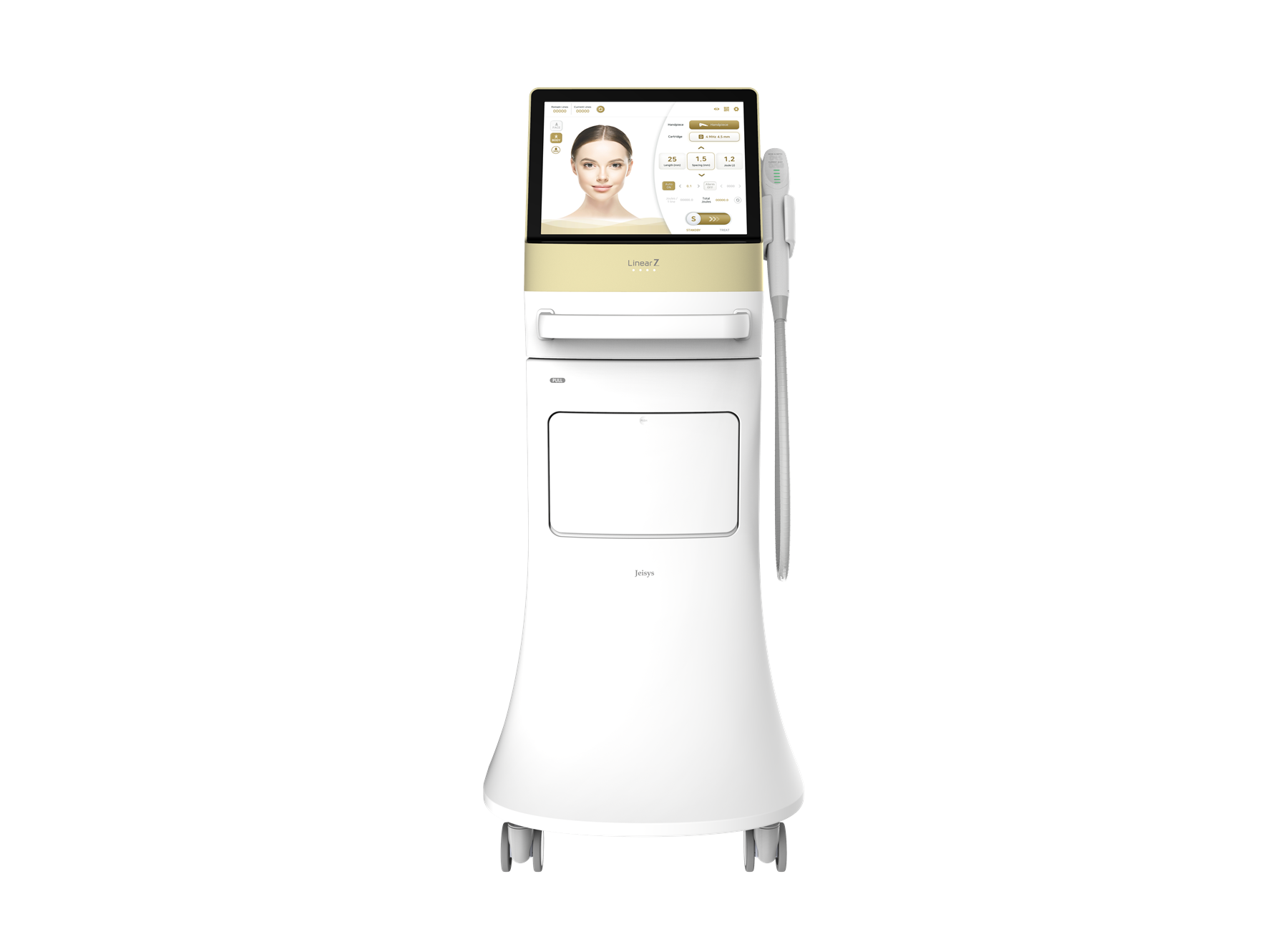
LinearZ offers two energy-delivery patterns, Dot and Linear, and four cartridge families. At Glassy, the dermatologist selects coverage, available depth and energy separately for different areas and goals. This gives the treatment plan more than one delivery geometry.
Ultherapy uses microfocused ultrasound with real-time imaging. Its official description explains that the practitioner can view tissues before and during treatment. A cartridge menu and live tissue visualization answer different questions; adjustable depth should not be presented as equivalent to seeing the patient’s actual tissue layers.
Ultherapy treatment can also be personalised. Describing LinearZ as customised does not establish that Ultherapy always uses identical settings across the face. The clinical question is which approach fits the person’s anatomy and concern.
| Question | LinearZ | Ultherapy |
|---|---|---|
| Delivery | Dot and Linear modes | Microfocused ultrasound with visualization |
| Planning feature | Cartridge-dependent depth and mode choices | Real-time ultrasound imaging before and during treatment |
| Personalisation | Mode, cartridge, depth, energy and coverage selected by area | Imaging helps guide individual targeting and planning |
| Clinical winner? | The sources reviewed do not establish universal superiority of LinearZ over Ultherapy. | |
Device descriptions: Jeisys Medical · LinearZ product, modes and cartridge specifications · Ultherapy · Official technology overview. Ultherapy is discussed for comparison and is not offered at Glassy.
Source: Jeisys Medical · LinearZ product, modes and cartridge specifications · Ultherapy · Official technology overview.
A technical comparison is not a head-to-head trial
A 2026 LinearZ case series discusses differences from Ultherapy, but all participants received LinearZ. It enrolled 38 Korean adults and 32 completed 12-week follow-up. There was no Ultherapy arm, sham treatment or randomised device comparison. Its results cannot show that LinearZ is better, safer or less painful than Ultherapy.
A Korean split-face study published in 2025 compared two-depth and three-depth LinearZ protocols in 22 women through 16 weeks. Between-protocol eyebrow-lifting differences were not statistically significant. It supports studying depth selection, not claiming that adding depths guarantees stronger lifting. Jeisys helped fund this study.
The sources reviewed for this guide did not provide a verified head-to-head clinical trial establishing LinearZ or LinearFirm as superior to Ultherapy. This is a search finding, not a claim that no such paper could exist. Do not compare percentages or pain scores from unrelated studies as though their patients and methods were equivalent.
Source: Plastic and Reconstructive Surgery Global Open, 2026 · Dual-mode LinearZ case series · Medical Lasers, 2025 · Two-depth versus three-depth LinearZ split-face study.
LinearZ, LinearFirm and Ultraformer are different names
Jeisys’s generation history describes ULTRAcel, LinearFirm and then LinearZ. LinearFirm belongs to the earlier Jeisys platform, commonly identified as ULTRAcel Q+. Findings for an earlier platform should retain that device name and should not be relabelled as a trial of the current LinearZ.
Ultraformer is manufactured by CLASSYS. Ultraformer III and Ultraformer MPT studies are not LinearZ studies. A comparison involving another Korean HIFU device cannot establish a LinearZ-specific advantage.
For example, the abstract of Jung and colleagues’ 2016 blinded split-face study reports two HIFU devices and 20 Korean patients, but does not name the devices. Without verified full methods, it should not be promoted as a LinearZ–Ultherapy comparison.
Source: Jeisys Medical · ULTRAcel, LinearFirm and LinearZ device history · CLASSYS · ULTRAFORMER MPT.
Fullness under the chin and hollow cheeks need different plans
At Glassy, the treatment discussion distinguishes areas where contour reduction may be useful from areas where preserving volume is a priority. An individual can have both submental fullness and lateral cheek hollowing; applying the same intent everywhere may miss that distinction.
Your dermatologist can change the mode, cartridge, available depth, energy and coverage between areas, or decide that an area should not receive ultrasound. Skin type and sensitivity also contribute to the plan. This is a clinical planning approach, not a guarantee that unwanted volume change cannot occur.
The useful comparison is an explanation of your own plan, its likely limits and alternatives. Do not use a schematic depth drawing to choose treatment parameters yourself.
Compare pain using the same measurement
At Glassy, LinearZ discomfort is usually estimated at 4–5/10 without optional numbing cream and 2–3/10 with it, based on clinic experience. The sensation is usually prickling. There is no sedation. These figures are not a comparison with Ultherapy.
To make a valid pain comparison, studies would need comparable patients, treatment areas, energy delivery, anaesthetic preparation and the same scale at the same time point. A social-media clip or another clinic’s score does not provide that controlled comparison.
Glassy may also discuss GLT™ Tri-Energy Triple Lifting to balance different treatment aims and comfort. Whether a combination improves outcomes or reduces pain relative to another protocol needs evidence for that actual comparison.
Questions to bring to the consultation
Ask which change you are targeting, where volume should be preserved, why each area is included, and what the selected mode and depth are intended to address. Then discuss expected recovery, follow-up and the complete quote.
If you are comparing a named paper or video, bring its link. Check the exact device, whether it studied people or tissue models, what the comparison group received, who funded it and how long outcomes were followed.
Glassy does not offer Ultherapy. This comparison helps explain options and limitations; it is not a promise that the clinic’s device is the best choice for every patient.
Sources and how to read them
- Jeisys Medical · LinearZ product, modes and cartridge specifications
Official product description. Nominal depths below follow its Specifications table; its depth graphic differs, and 0.5-mm steps are described as ACCU-series only. Exact cartridge options need model-specific verification.
- Plastic and Reconstructive Surgery Global Open, 2026 · Dual-mode LinearZ case series
38 Korean adults enrolled; 32 completed 12-week follow-up. Single-arm case series without a sham control; hollow-prone faces were excluded. Longer-term durability remains uncertain.
- Cells, 2023 · HIFU, collagen and elastin in experimental models
Laboratory and animal research using LinearZ; it does not establish a person’s result, treatment interval or duration of benefit.
- US FDA · Non-invasive body contouring technologies, ultrasound section
General ultrasound safety context, not a LinearZ-specific approval or a facial treatment protocol.
- Sofwave · Official safety information
Sofwave-specific indications, precautions and adverse events; these are not interchangeable with LinearZ instructions.
- Sofwave · Ultrasound technology overview
Manufacturer overview describing mid-dermal ultrasound; it does not establish superiority over another device.
- Ultherapy · Official technology overview
Manufacturer information about real-time ultrasound imaging; this is a technical distinction, not a head-to-head outcome trial.
- Medical Lasers, 2025 · Two-depth versus three-depth LinearZ split-face study
22 Korean women; follow-up to 16 weeks. Between-protocol lifting differences were not statistically significant. Funded by Jeisys and a Korean health research grant; no Ultherapy arm.
- Jung et al., 2016 · Evaluator-blinded split-face comparison of two HIFU devices
20 Korean patients; abstract describes similar efficacy. Device names are not in the abstract available here. Do not identify it as a LinearZ–Ultherapy trial without verifying full methods.
- CLASSYS · ULTRAFORMER MPT
Official manufacturer identification. Ultraformer is a CLASSYS platform, distinct from Jeisys LinearZ.
- Jeisys Medical · ULTRAcel, LinearFirm and LinearZ device history
Manufacturer generation history; predecessor studies do not automatically establish outcomes for the current system.
Manufacturer descriptions, research and clinic practices describe different evidence. This clinic-review edition does not claim a clinical review endorsement.