From the Blog · Glassy Skin Clinic
How Does Juvelook Build Collagen? The Repair-Cell (M2) Pathway, Simply Explained
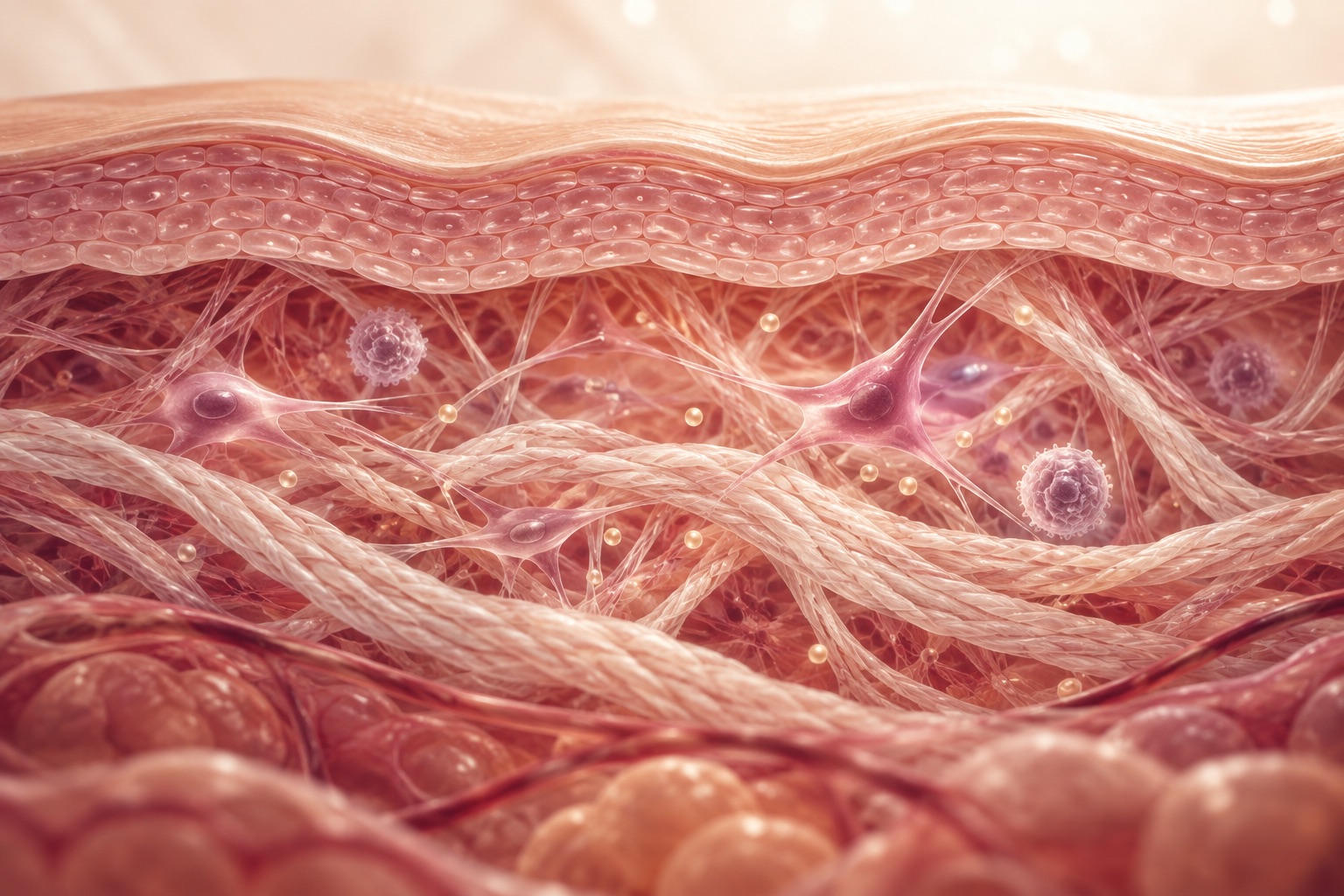
Juvelook's PDLLA particles set off a controlled response in the skin in which repair-type (M2) immune cells play a central role. According to the manufacturer and an animal study in aged mice, these cells release IL-10, which supports stem cells and fibroblasts that make new collagen and elastin, while collagen-breaking enzymes (MMPs) go down. Most of this mechanism comes from animal and lab studies, so results in people build gradually and vary.
In this article
How does Juvelook build collagen?
Juvelook builds collagen by setting off a controlled repair response in your skin, not by filling space with gel. Its PDLLA (poly-D,L-lactic acid) particles cause what the manufacturer (Vaim) calls a foreign-body response in the dermis. [1] In that response, repair-type immune cells called M2 macrophages play a central role. They send signals that lead to more fibroblasts, the cells that make collagen and elastin. [1][2]
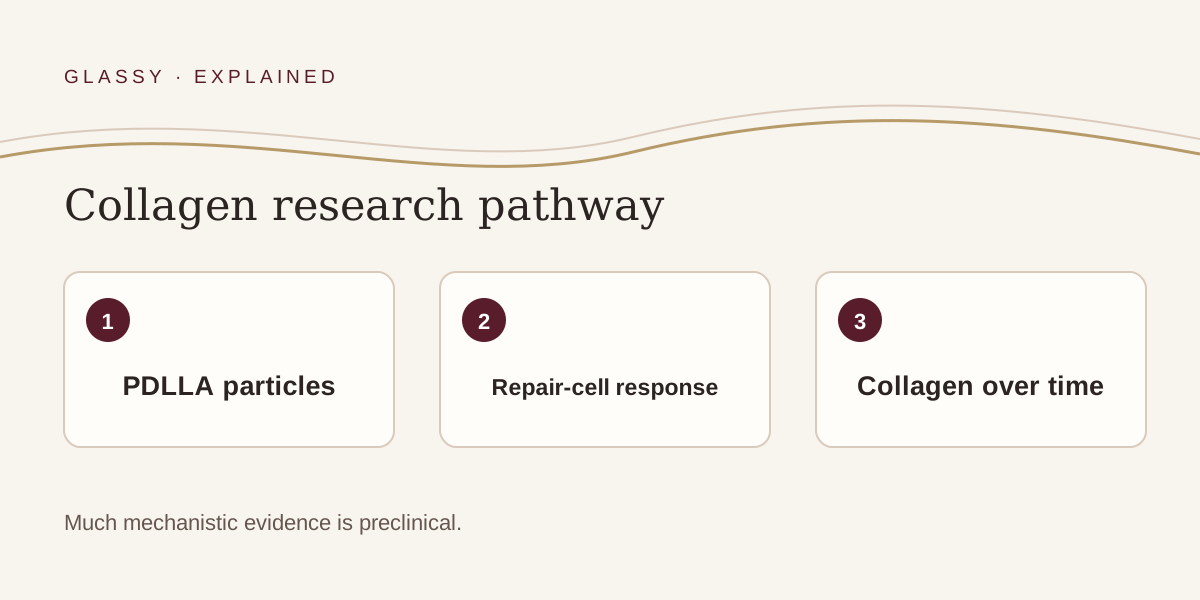
This sequence is described by the manufacturer and comes mainly from an animal study in aged mice. [2] Here is what it means in plain language.
What happens in the skin, step by step?
Think of the particles as a signal that tells your skin, "Repair this area." The table below follows the manufacturer's description and shows the type of evidence behind each step.
| Step | What happens | Evidence type |
|---|---|---|
| 1. Controlled response | PDLLA particles in the dermis trigger a foreign-body response. Resting immune cells (M0 macrophages) change into M1 and M2 types. | Manufacturer [1] |
| 2. Repair cells take the lead | PDLLA shifted aged immune cells toward the M2 (repair-type) state. | Lab (cell) study and animal study (mice) [2] |
| 3. IL-10 rises | M2 cells release IL-10, a calming (anti-inflammatory) signal. IL-10 rose over time in PDLLA-injected skin. | Animal study (mice) [2] |
| 4. Stem cells and fibroblasts | IL-10 supports adipose-derived stem cells, which help fibroblasts grow. | Manufacturer, lab and animal study [1][2] |
| 5. New collagen and elastin | Collagen and elastin were highest 8 weeks after injection. | Animal study (mice) [2] |
| 6. Less breakdown | NF-κB goes down, which lowers MMPs, the enzymes that break down collagen. | Lab (cell) study [2]; animal study (mice) [3] |
Two related studies from the same research group, in cells and mice, point the same way. In one, PDLLA restored the M2 balance in aged immune cells. [4] In the other, collagen-breaking enzymes (MMP2 and MMP9) fell 4 weeks after PDLLA injection in UV-exposed skin. [3]
Does Juvelook cause inflammation?
It causes a controlled response, which is different from the red, painful inflammation of an infection. Researchers who studied Juvelook in rabbits (an animal study) describe "controlled macrophage-mediated tissue remodelling" that goes along with PDLLA breaking down and collagen being laid down. [5]
Balance matters, though. The same authors note that "excessive or persistent inflammatory responses may contribute to delayed nodules or granulomatous reactions." [5] The manufacturer describes nodules as clumped particles. [1] So when particles clump in one spot, the response there can become too strong. That's why even mixing and even placement matter. For more, see Juvelook lumps and nodules.
What do the particles and the hyaluronic acid do?
The particles. The manufacturer describes each PDLLA particle as porous, with a net-like inside that is about 80% air. [1] It breaks down slowly from the inside. According to the manufacturer, this avoids a sudden change in acidity around the particle and allows even collagen production. [1]
The hyaluronic acid (HA) carrier. The particles are suspended in non-cross-linked HA. The manufacturer says the HA gives an immediate filling and hydrating effect, helps prevent swelling, and keeps particles from clogging the needle. [1] This HA effect is short-term. The longer-lasting change comes from your own collagen.
Juvelook comes in several versions with different particle sizes and depths. See Juvelook products explained. For a neutral comparison with a PLLA product, see Juvelook vs Sculptra. We don't offer Sculptra.
Why are results gradual?
Your skin has to build the collagen itself, and that takes weeks. In the mouse study, collagen and elastin were measured at 2, 4 and 8 weeks and were highest at 8 weeks, the last time point measured. [2] In our clinic's experience, in principle, your own collagen starts to form from about one month after treatment and keeps building over the second and third months and beyond. The manufacturer (Vaim) describes Juvelook's effect as lasting about 12–18 months; that is the manufacturer's claim, not a promise. [1]
This is also why sessions are spaced weeks apart: each round of repair needs time to work before the next one. Even one session gives results, and how to plan more is explained in how many Juvelook sessions you need.
What are the honest limits of this research?
So we explain the mechanism as the most complete explanation we have today, not as proof of what will happen in your skin.
How we support this at Glassy Skin Clinic
At our clinic, we try to support this repair process by keeping the particles even and the placement gentle. We hydrate Juvelook with saline and add a local anesthetic for comfort, and it's prepared in three mixing steps: vortex, a second vortex right before treatment, and syringe-to-syringe mixing (how we prepare Juvelook). Board-certified dermatologists then place it with GLT™ (Gentle Layered Treatment), in thin layers rather than in one spot, without sedation. For skin quality, this is our GLT™ Collagen Healer with Juvelook.
Side effects and who shouldn't have Juvelook: see our Juvelook treatment page.
Message us on WhatsApp or Instagram DM (@glassyskinclinic_global), or use our booking form. Please book at least one day ahead.
Related: What is Juvelook? · Juvelook products explained · How many Juvelook sessions?
Your questions
FAQ
Frequently asked questions
Is Juvelook a filler?
Not in the usual sense. Juvelook is a collagen stimulator made of PDLLA particles in non-cross-linked hyaluronic acid. The hyaluronic acid gives a short-term hydrating effect, but the main change comes from the collagen your own skin builds over the following weeks and months.
How long until Juvelook builds collagen?
It happens gradually. In an animal study in aged mice, collagen and elastin were highest at 8 weeks, the last time point measured. In our clinic's experience, in principle, your own collagen starts to form from about one month after treatment and keeps building over the second and third months and beyond, even after a single session.
Does Juvelook cause inflammation?
It causes a controlled response, not ordinary inflammation. The manufacturer describes a foreign-body response in which repair-type (M2) immune cells play a central role. If particles clump in one spot, that response can become excessive there, which is one way a nodule can form. That's why even mixing and even placement matter.
Is the Juvelook mechanism research done in humans?
Mostly not yet. The step-by-step mechanism comes from animal and lab studies, several of them supported by or involving the manufacturer. Human studies of the PDLLA and hyaluronic acid combination exist but are smaller and preliminary.
Why are Juvelook results gradual?
Because your skin has to make the new collagen itself. The particles break down slowly, and the repair process continues for weeks after each session. That's also why sessions are spaced weeks apart rather than done all at once.

Written & medically reviewed by
Dr. Judy Hong Jin Joo, MD
Written and medically reviewed by Dr. Judy Hong Jin Joo, MD, board-certified dermatologist (Korea) and Founder & Medical Director of Glassy Skin Clinic. She trained in dermatology at Seoul St. Mary's Hospital, The Catholic University of Korea. She is the first author of a randomized clinical trial on hyaluronic acid filler published in Plastic and Reconstructive Surgery, 2016;137(3):799–808.
Continue exploring
Related articles & treatments
Related treatments2
Articles & guides4
Related reading
Is More-Diluted Juvelook Weaker? What Dilution Really Means for Results and Nodules
No — as long as you receive the same vial or vials.
Read the guide
How Many Juvelook Sessions Do You Need, and How Far Apart?
Even one Juvelook session gives results, and repeated sessions build on it: the manufacturer's standard course for Juvelook and Juvelook Volume is three sessions.
Read the guide
What Is Juvelook? A Dermatologist in Seoul Explains
Juvelook is a Korean collagen-stimulating injectable made of PDLLA (poly-D,L-lactic acid) and non-crosslinked hyaluronic acid.
Read the guide