From the Blog · Glassy Skin Clinic
Is More-Diluted Juvelook Weaker? What Dilution Really Means for Results and Nodules
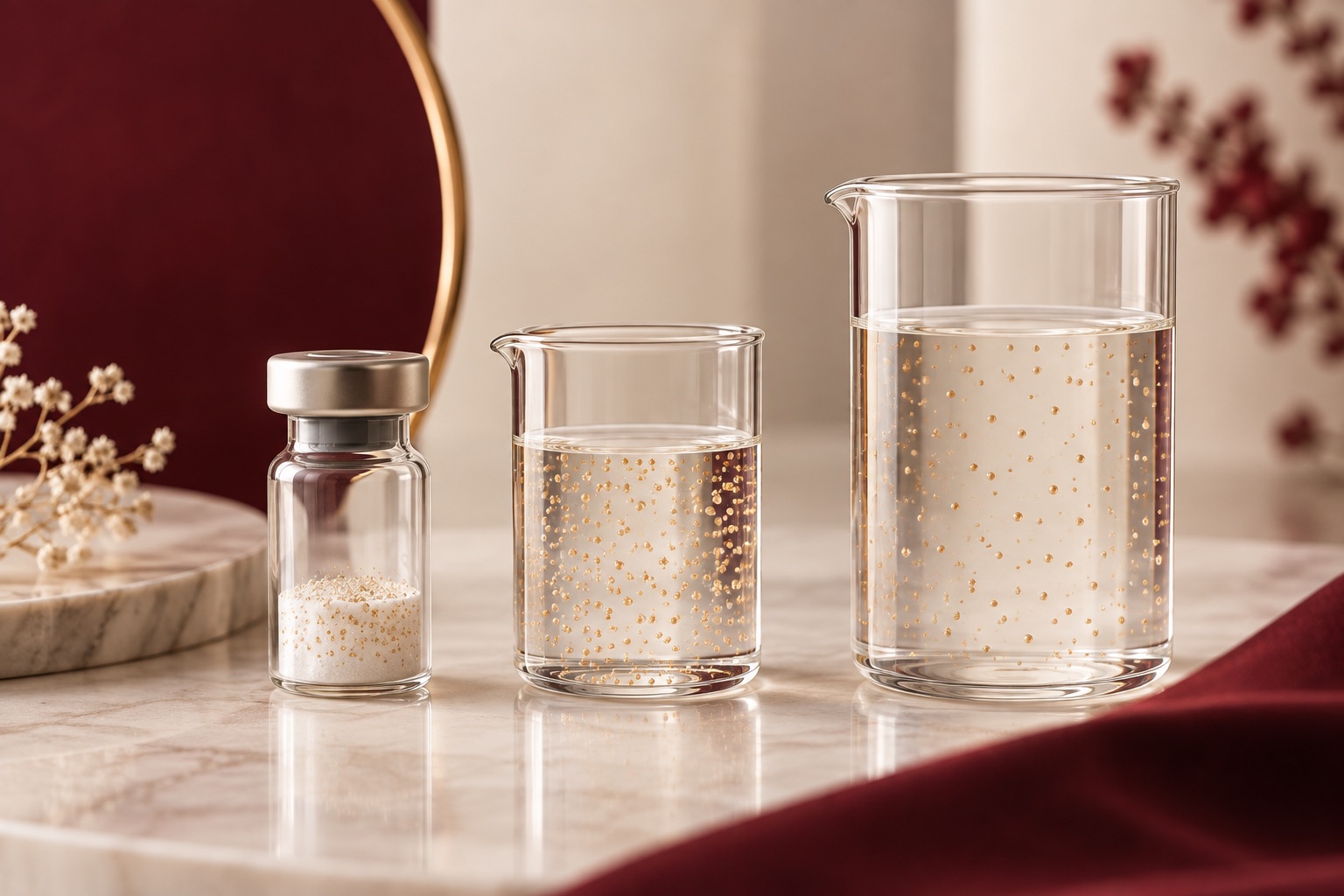
No — as long as you receive the same vial or vials. Adding liquid to Juvelook spreads the same amount of PDLLA more evenly; it doesn't take any product away. The manufacturer's public English brochure lists 6 mL for the 50 mg Juvelook vial and 8 mL for the 200 mg Juvelook Volume (Lenisna) vial, so a number of mL only means something when you also know the vial.
In this article
Is more-diluted Juvelook weaker?
No — as long as you receive the same vial or vials. Dilution changes how concentrated each mL is, but the total amount of PDLLA (poly-D,L-lactic acid) is set by the vial you are treated with. [1] What matters is which product and how many vials you receive, and whether the particles are placed evenly in the right layer.
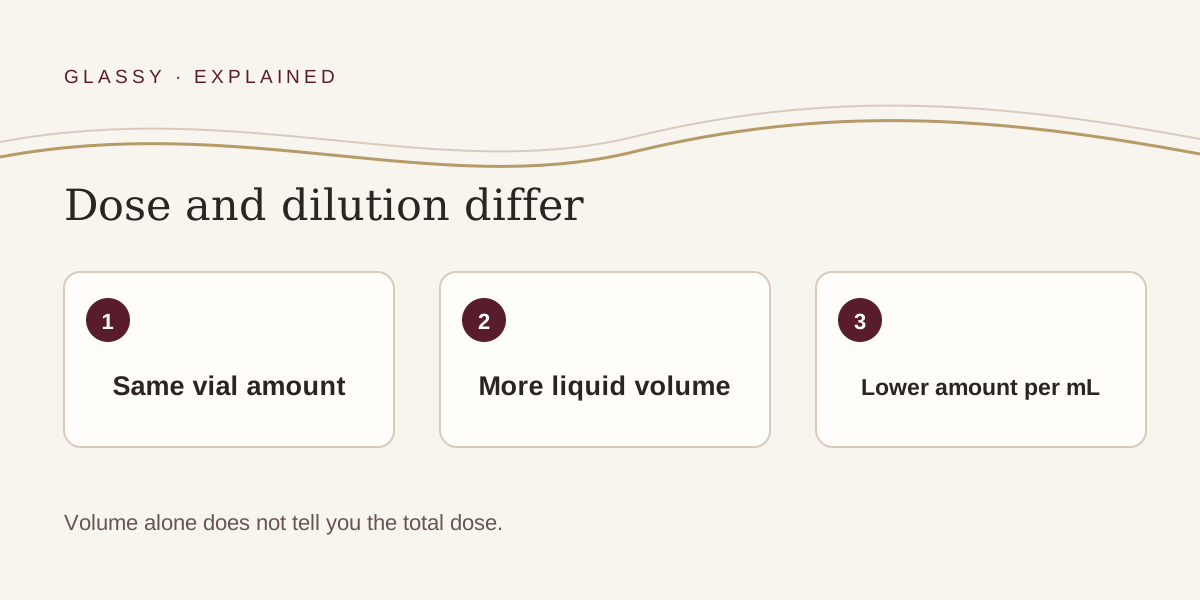
Juvelook works by stimulating your own collagen, so even distribution matters more than a "stronger" mix. [2] You can read how that tissue response works in how Juvelook builds collagen.
How much saline does each Juvelook vial need?
The manufacturer, Vaim, lists the contents of every vial on its official product page. [1] Its public English brochure gives a reconstitution volume for its two main vials: 6 mL for the 50 mg Juvelook vial (8 mL when treating stretch marks) and 8 mL for the 200 mg Juvelook Volume vial, sold abroad as Lenisna (10–20 mL for body areas). [2]
| Product | Vial | PDLLA + HA | Reconstitution volume (manufacturer's public documents) | PDLLA per mL |
|---|---|---|---|---|
| Juvelook i | 30 mg | 25.5 + 4.5 mg | Not listed | — |
| Juvelook Skin | 30 mg | 25.5 + 4.5 mg | Not listed | — |
| Juvelook | 50 mg | 42.5 + 7.5 mg | 6 mL | about 7.1 mg |
| Juvelook Volume 100 | 100 mg | 85 + 15 mg | Not listed | — |
| Juvelook Volume (Lenisna) | 200 mg | 170 + 30 mg | 8 mL | about 21.3 mg |
| Juvelook G | 200 mg | 170 + 30 mg | Not listed | — |
Sources: [1], [2]. PDLLA per mL is calculated from the published figures. "Not listed" means we could not find a figure in Vaim's public documents.
At these public volumes, Juvelook Volume is about three times more concentrated per mL than skin-layer Juvelook. That fits its purpose: it is placed deeper, in the lower dermis and fat layer, to restore volume. [2]
Why "mL" alone doesn't tell you the dose
A syringe labeled "4 mL of Juvelook" could hold very different amounts of product. Four mL from a 50 mg vial mixed with 6 mL contains about 28 mg of PDLLA. Four mL from a 200 mg Volume vial mixed with 8 mL contains about 85 mg — three times as much.
That's why, when you compare treatment plans or quotes, the more useful questions are:
If you've seen a per-cc quote, what a Juvelook 1 cc price actually buys looks at the same problem from the price side.
Why do Lenisna numbers differ abroad?
Lenisna is the name used for Juvelook Volume in some markets outside Korea, including Brazil and Europe. [3][4] Each vial contains the same 170 mg of PDLLA and 30 mg of hyaluronic acid. [1][5]
Vaim's 2023 English brochure lists 8 mL for this 200 mg vial, and 10–20 mL for body contouring and body skin laxity. [2] The UK brochure from Vaim's partner FILLMED describes 6 mL in the vial plus 4 mL added in a syringe, for a total of 10 mL for Lenisna, [4] and practitioners in some countries adjust the volume by treatment area. So if you were treated abroad with a different number of mL, it doesn't by itself mean you received more or less product. Ask how many vials you received, and we're happy to explain the difference at your consultation.
Can too little dilution cause nodules?
A nodule is a small, firm bump under the skin; the manufacturer describes Juvelook nodules as clumped particles ("massed PDLLA particles") and calls them a minor side effect. [2]
The strongest human data on dilution come from a related product, poly-L-lactic acid (PLLA, the ingredient in Sculptra — a product we don't offer). [6] A 2026 review found that early PLLA protocols using only 2–3 mL of water per vial had high nodule rates, and it cites a study where 10–12 mL dilution was associated with a 1.3% nodule rate versus 8% with a standard protocol. [7] PLLA and PDLLA are different materials, so these numbers can't be transferred directly to Juvelook. But the principle — evenly dispersed particles are less likely to clump — is consistent: an expert consensus on PDLLA microspheres attributes nodules mainly to "abnormal accumulation of the product." [8]
Dilution is only one factor; depth, placement and mixing matter too. At our clinic, if a nodule is suspected, our dermatologists inject sterile saline into it, then use RF microneedling (3DEEP, EndyMed, Israel) to warm the area so the PDLLA particles soften, and combine this with firm, controlled massage and more saline to break it up. Energy-based devices have been reported for managing nodules after PDLLA injection in the tear trough, [9] and recent case reports also describe extracorporeal shock wave therapy for nodules after cosmetic injections. [10] Causes, prevention and when to contact us are covered in Juvelook lumps and nodules.
How we prepare Juvelook at Glassy Skin Clinic
- Hydrated and prepared in three steps. At our clinic, we hydrate Juvelook with saline and add a local anesthetic for comfort. It's prepared in three steps: first mixed on a vortex mixer, mixed again on the vortex right before your treatment, and then mixed back and forth between syringes (how we prepare Juvelook). The exact amounts and times are part of our clinic protocol.
- Board-certified dermatologists inject every treatment. Dr. Judy (Hong Jin Joo) or one of our four board-certified dermatologists chooses the product, layer and technique for your concern — skin-layer Juvelook for texture and fine lines, Juvelook Volume for lost volume.
- Layered placement with GLT™ (Gentle Layered Treatment). In GLT™ Collagen Healer and GLT™ Collagen Volume Lifting, product is spread across layers rather than concentrated in one spot.
After Juvelook Volume, right after treatment, a nurse trained by our dermatologists shows you how to massage the area firmly for 1–2 minutes, and your dermatologist checks once more that you're doing it correctly; there's no daily home routine (do you need to massage after Juvelook?). We explain the possibility of nodules and what to do before every treatment.
Who should not get Juvelook?
Juvelook isn't suitable for everyone — for example, during pregnancy or with an active infection or inflammation in the treatment area. [8] See who should not have Juvelook, and tell your doctor about any fillers you've had and any past reactions.
Message us on WhatsApp or Instagram DM (@glassyskinclinic_global), or use our booking form. Please book at least one day ahead.
Related: Juvelook · GLT™ Collagen Volume Lifting · Juvelook lumps and nodules · Why Juvelook is mixed in a vortex mixer · How many Juvelook sessions do you need? · Juvelook vs Sculptra
Your questions
FAQ
Frequently asked questions
Does more saline mean I'm getting less Juvelook?
No. The amount of PDLLA is fixed by the vial — 25.5 mg in a 30 mg vial, 42.5 mg in a 50 mg vial and 170 mg in a 200 mg vial. Liquid changes how concentrated each mL is, not how much product you receive in total. Ask how many vials, or how many mg, you are getting.
How much saline should Juvelook be mixed with?
Vaim's public 2023 English brochure lists 6 mL for the 50 mg Juvelook vial (8 mL for stretch marks) and 8 mL for the 200 mg Juvelook Volume vial, sold abroad as Lenisna (10–20 mL for body areas), with 1–2 mL of lidocaine as an optional addition. Vaim's UK partner, FILLMED, lists 10 mL in total for Lenisna. We could not find public figures for the other vials.
Can too little dilution cause lumps?
It may be one factor. In studies of a related product (PLLA), very low dilution was linked to more nodules, and the manufacturer describes Juvelook nodules as clumped particles. Depth, placement and mixing matter too — our article on Juvelook lumps and nodules covers causes and treatment.
Is Juvelook Volume the same as Lenisna?
Yes. Lenisna is the name used for Juvelook Volume in some markets outside Korea, including Brazil and Europe. It contains the same 170 mg of PDLLA and 30 mg of hyaluronic acid per vial.

Written & medically reviewed by
Dr. Judy Hong Jin Joo, MD
Written and medically reviewed by Dr. Judy Hong Jin Joo, MD, board-certified dermatologist (Korea) and Founder & Medical Director of Glassy Skin Clinic. She trained in dermatology at Seoul St. Mary's Hospital, The Catholic University of Korea. She is the first author of a randomized clinical trial on hyaluronic acid filler published in Plastic and Reconstructive Surgery, 2016;137(3):799–808.
Continue exploring
Related articles & treatments
Related treatments2
Articles & guides4
Related reading
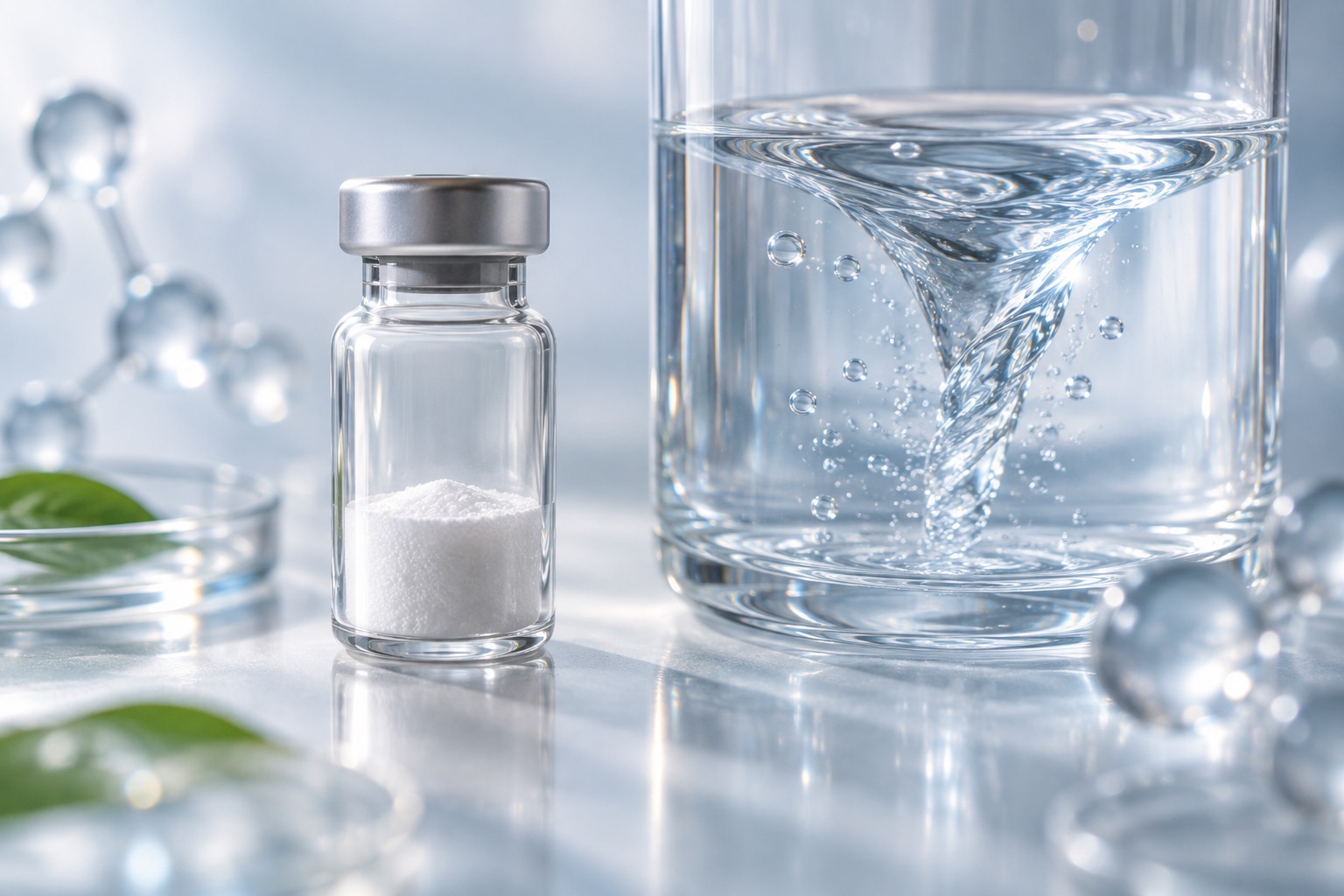
Why Is Juvelook Mixed in a Machine? Hydration, Vortex Mixing and Timing
Juvelook comes as a dry powder of PDLLA particles and hyaluronic acid, and it has to be fully hydrated so the particles are evenly suspended before injection.
Read the guide
Juvelook Lumps and Nodules: Why They Happen and How Dermatologists Treat Them
Nodules after Juvelook are uncommon and are usually small clumps of PDLLA particles.
Read the guide
What Is Juvelook? A Dermatologist in Seoul Explains
Juvelook is a Korean collagen-stimulating injectable made of PDLLA (poly-D,L-lactic acid) and non-crosslinked hyaluronic acid.
Read the guide