
From the Blog · Glassy Skin Clinic
Juvelook Lumps and Nodules: Why They Happen and How Dermatologists Treat Them
Nodules after Juvelook are uncommon and are usually small clumps of PDLLA particles. Early bumps in the first days are usually swelling that settles on its own; a firm lump that persists for weeks should be examined. Because hydrated PDLLA softens at about 39°C, the manufacturer describes managing a nodule with extra saline, gentle heat from an energy-based device, and pressure — usually without surgery.
In this article
Can Juvelook cause lumps or nodules?
Yes, but it's uncommon. Juvelook's manufacturer, Vaim, describes nodules as a "minor side effect" and explains them as clumps of PDLLA particles ("massed PDLLA particles"). [1] A nodule is a small, firm bump under the skin that you can feel and sometimes see.
It helps to separate two things:
| What it is | What usually happens | |
|---|---|---|
| Early bumps (first days) | Swelling, injected fluid, occasional bruising | Settle on their own. In our clinic's experience, swelling after Juvelook Volume (GLT™ Collagen Volume Lifting) lasts 3–7 days on average and 10–14 days in some people; bruising is uncommon and usually clears within about 2 weeks |
| Nodule (weeks later) | A firm clump of particles, sometimes with a local tissue reaction | Should be examined by your doctor; usually treatable without surgery |
In the related poly-L-lactic acid (PLLA) literature, nodules that appear in the first few weeks are mostly non-inflammatory, while nodules that appear several months later suggest a foreign-body (granulomatous) reaction. [2]
Why do nodules form after Juvelook?
Juvelook works by triggering a controlled tissue response that builds new collagen. When particles are spread evenly, that response is spread evenly too. When too many particles collect in one spot, the response can become concentrated there. Researchers studying Juvelook and Juvelook Volume in an animal model noted that "excessive or persistent inflammatory responses may contribute to delayed nodules or granulomatous reactions." [3]
An expert consensus on PDLLA microspheres puts it simply: nodules "are mainly caused by improper injection techniques," which result in "abnormal accumulation of the product." [4]
Common contributing factors:
How are Juvelook nodules treated?
Juvelook's particle material has a useful property. Vaim's brochure explains that PDLLA's glass transition temperature — the point where it changes from rigid to soft — drops from about 50°C when dry to about 39°C after it is hydrated. [1] That is close to body temperature.
Because of this, the manufacturer describes a non-surgical approach: [1]
- Extra saline is injected into the nodule to loosen the clumped particles.
- Gentle heat from an energy-based device, such as radiofrequency, softens the PDLLA.
- Pressure spreads the softened particles out, flattening the lump.
Your doctor will examine the lump first, because the right approach depends on whether it is a simple clump or an inflammatory reaction. [2]
At our clinic, if a nodule is suspected, our dermatologists inject sterile saline into it, then use RF microneedling (3DEEP, EndyMed, Israel) to warm the area so the PDLLA particles soften (move past their glass-transition state), and combine this with firm, controlled massage and more saline to break the nodule up.
Energy-based devices have been reported for managing nodules after PDLLA injection in the tear trough, [6] and recent case reports also describe extracorporeal shock wave therapy for nodules after cosmetic injections. [7]
How are nodules prevented?
Most prevention happens before and during treatment: [1][4][5]
How we handle it at Glassy Skin Clinic
When should you contact your clinic?
Contact the clinic that treated you if you notice:
A tender, warm or red swelling can signal inflammation or infection and needs prompt assessment. [2]
The day after every treatment, our team contacts you to ask about any discomfort (our "Happy Call"). If you notice a bump after you fly home, send us a clear photo in daylight via WhatsApp or Instagram and tell us when you first noticed it (care for international patients). Don't try to massage a persistent lump hard or treat it yourself.
Who should not get Juvelook?
Juvelook isn't suitable for everyone — for example, during pregnancy or with an active infection or inflammation in the treatment area. [4] See who should not have Juvelook, and tell your doctor about any fillers you've had and any past reactions.
Message us on WhatsApp or Instagram DM (@glassyskinclinic_global), or use our booking form. Please book at least one day ahead.
Related: Is more-diluted Juvelook weaker? · Do you need to massage after Juvelook? · Under-eye treatment options · Under-eye and mid-cheek hollows
Your questions
FAQ
Frequently asked questions
Can Juvelook cause lumps?
It can, but it's uncommon. The manufacturer describes nodules as a minor side effect caused by clumped PDLLA particles. Most can be softened and dispersed without surgery.
How soon after Juvelook can a nodule appear?
Small bumps in the first days are usually swelling or the injected fluid and settle on their own. After Juvelook Volume (GLT™ Collagen Volume Lifting), swelling lasts 3 to 7 days on average and 10 to 14 days in some people, in our clinic's experience. A firm nodule that forms or persists weeks later should be checked by your doctor.
How is a Juvelook nodule treated?
The manufacturer describes injecting extra saline into the nodule, warming it with an energy-based device such as radiofrequency, and applying pressure to spread the particles. At our clinic, if a nodule is suspected, our dermatologists inject sterile saline, warm the area with RF microneedling so the PDLLA particles soften, and add firm, controlled massage and more saline to break it up.
Should I massage a lump myself?
Don't massage a persistent lump hard on your own. Contact your clinic so a doctor can examine it first.
Are nodules more likely under the eyes?
Thin skin under the eyes makes any unevenness easier to see and feel, so product choice, depth and technique matter most there. Fine lines and hollows under the eyes are treated with different products in different layers.

Written & medically reviewed by
Dr. Judy Hong Jin Joo, MD
Written and medically reviewed by Dr. Judy Hong Jin Joo, MD, board-certified dermatologist (Korea) and Founder & Medical Director of Glassy Skin Clinic. She trained in dermatology at Seoul St. Mary's Hospital, The Catholic University of Korea. She is the first author of a randomized clinical trial on hyaluronic acid filler published in Plastic and Reconstructive Surgery, 2016;137(3):799–808.
Continue exploring
Related articles & treatments
Related treatments2
Articles & guides4
Related reading
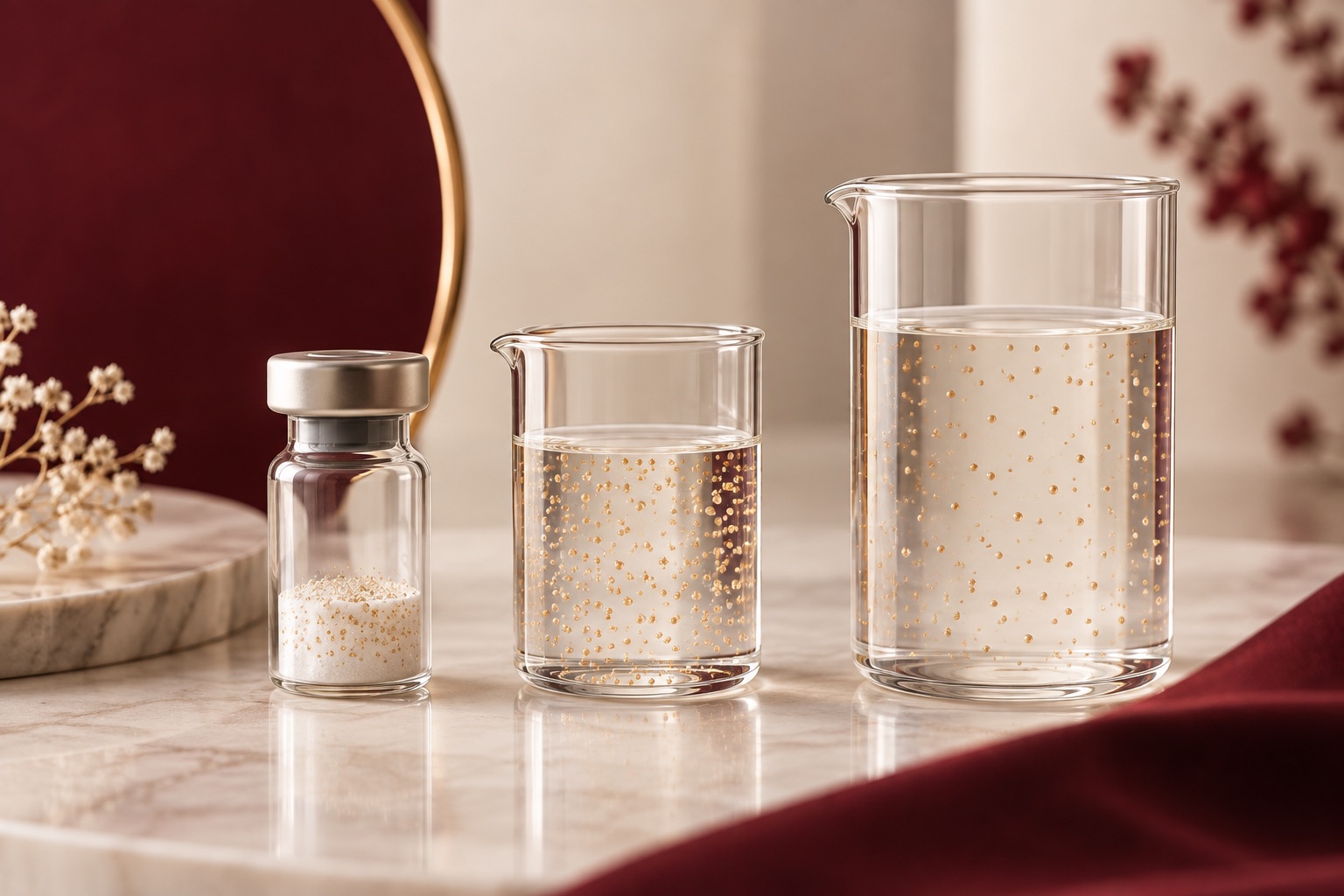
Is More-Diluted Juvelook Weaker? What Dilution Really Means for Results and Nodules
No — as long as you receive the same vial or vials.
Read the guide
Do You Need to Massage After Juvelook or Juvelook Volume? A Dermatologist Explains
Juvelook and Juvelook Volume don't come with a daily home-massage routine like Sculptra's "5-5-5" rule (5 minutes, 5 times a day, for 5 days).
Read the guide
What Is Juvelook? A Dermatologist in Seoul Explains
Juvelook is a Korean collagen-stimulating injectable made of PDLLA (poly-D,L-lactic acid) and non-crosslinked hyaluronic acid.
Read the guide