From the Blog · Glassy Skin Clinic
Juvelook Volume vs Sculptra: PDLLA vs PLLA Explained
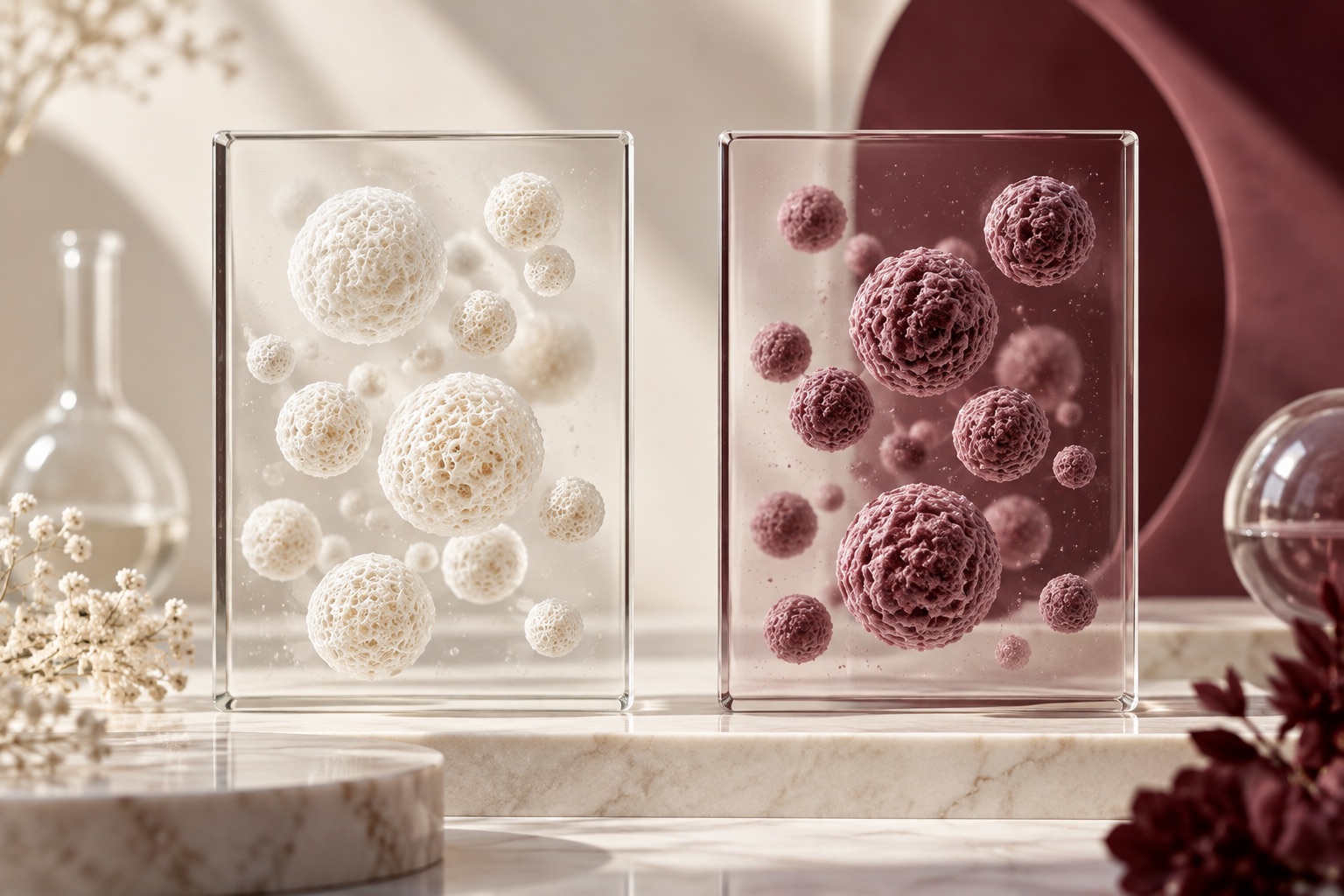
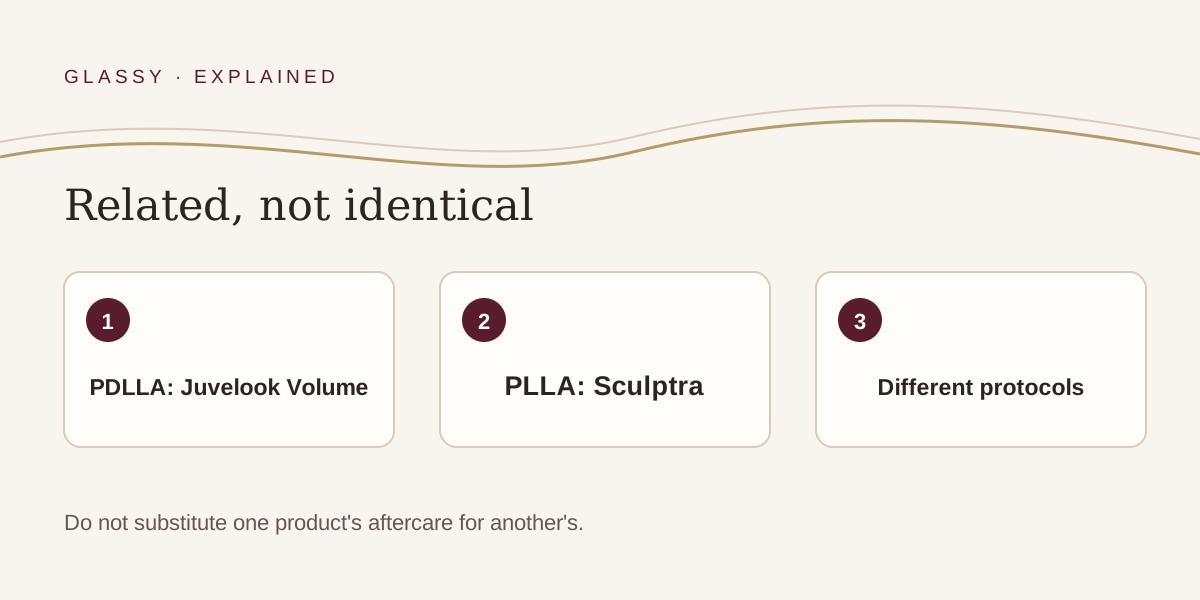
Juvelook Volume and Sculptra are both collagen stimulators, but they use different ingredients. Juvelook Volume (sold as Lenisna in some countries) combines porous, spherical PDLLA (poly-D,L-lactic acid) particles with non-cross-linked hyaluronic acid, while Sculptra uses PLLA (poly-L-lactic acid) reconstituted with sterile water. Both work gradually over several weeks. Sculptra's official aftercare is a 5-day home massage routine; Juvelook Volume has no daily routine, just one short massage right after injection.
In this article
Is Juvelook Volume the same as Sculptra?
No. Juvelook Volume and Sculptra are both collagen stimulators, but they are different products with different ingredients. Juvelook Volume uses PDLLA (poly-D,L-lactic acid). [1] Sculptra uses PLLA (poly-L-lactic acid). [2] You may hear Juvelook Volume called "the Korean Sculptra," and the comparison makes sense because both work the same general way: they encourage your skin to build its own collagen over time. [3] Outside Korea, Juvelook Volume is sold in some countries as Lenisna. [4][5]
One note before we start: we don't offer Sculptra at Glassy Skin Clinic. This article compares the two so you can understand what you are reading about, whether you are researching at home or planning a visit to Seoul.
What is the difference between PDLLA and PLLA?
Both are forms of polylactic acid, a material the body gradually breaks down and absorbs. [6][7] The difference is in their structure.
In both cases, the particles are placed under the skin and the body responds by forming new collagen around them. The particles are slowly absorbed, and the new collagen remains. [3][6] That's why neither product gives an instant result. Changes build over several weeks to months. [2][8] With Juvelook Volume, in principle, your own collagen starts to form from about one month after treatment and keeps building over the second and third months and beyond.
Juvelook Volume vs Sculptra: side by side
| Sculptra | Juvelook Volume (Lenisna) | |
|---|---|---|
| Main ingredient | PLLA (poly-L-lactic acid) | PDLLA 170 mg per vial |
| Carrier | Carboxymethylcellulose and mannitol, reconstituted with sterile water | Non-cross-linked hyaluronic acid, 30 mg per vial |
| Particle description | PLLA microparticles | Porous, spherical microspheres (Vaim) |
| Aftercare massage | 5 min, 5 times a day, for 5 days (official FAQ) | One firm 1–2 min massage right after injection (Vaim's UK partner) |
| Sessions | Varies by treatment plan | At our clinic: one session gives results; for the fullest result, usually 3, 6–12 weeks apart |
| Available at our clinic | No | Yes |
Sources: [1], [2], [3], [5], [8], [9]. Session planning reflects our clinic's practice.
Why the carrier matters
Juvelook Volume uses non-cross-linked hyaluronic acid as its carrier. [3] According to Vaim, it gives some early hydration and helps prevent needle clogging. [5] Because it is non-cross-linked, it isn't designed to act as a lasting gel filler. With both products, the main long-term effect comes from your own collagen. [3][6]
Do you need to massage after Juvelook Volume and Sculptra?
The instructions differ. Sculptra's official FAQ asks for massage 5 minutes, 5 times a day, for 5 days. [8] For Juvelook Volume, Vaim's UK partner recommends one firm massage of 1–2 minutes right after injection, with no daily home routine. [9] At our clinic, right after treatment, a nurse trained by our dermatologists shows you how to massage the area firmly for 1–2 minutes, and your dermatologist checks once more that you're doing it correctly. For the full comparison, see massage after Juvelook.
Is Juvelook Volume FDA-approved?
No. Sculptra has been FDA-approved in the US since 2004. [10] PDLLA is not among the filler materials the FDA lists as approved, so Juvelook Volume is not FDA-approved. [11] It is approved as a medical device in Korea, [1] so you may not find it at home. If you have it in Seoul, keep a note of the product name for your doctor at home.
Side effects and safety: what's similar
Both products can cause swelling, redness, tenderness and bruising, which are usually temporary. [2][7] After Juvelook Volume (GLT™ Collagen Volume Lifting), swelling lasts 3–7 days on average; in some people it can last 10–14 days. In our clinic's experience this is part of the normal response as your skin starts building collagen. With both, firm lumps (nodules) can form, mainly when product builds up unevenly in one spot. [7] See Juvelook lumps and nodules. At our clinic, GLT™ Collagen Volume Lifting with Juvelook Volume isn't the right treatment for people who have had an autoimmune disease since childhood, such as Behçet's disease, lupus or rheumatoid arthritis. Every injectable treatment carries some risk, and your dermatologist will go through the ones that apply to you before treatment.
Getting Juvelook Volume in Seoul
At our clinic, Juvelook Volume is delivered as GLT™ Collagen Volume Lifting, using GLT™ (Gentle Layered Treatment) with a blunt cannula, by board-certified dermatologists. At our clinic, we hydrate Juvelook with saline and add a local anesthetic for comfort. It's prepared in three mixing steps: vortex, a second vortex right before treatment, and syringe-to-syringe mixing (how we prepare Juvelook). We usually treat under-eye hollows together with the mid-cheek; see under-eye and mid-cheek hollows and how we plan your visits.
Message us on WhatsApp or Instagram DM (@glassyskinclinic_global), or use our booking form. Please book at least one day ahead.
Related: Juvelook vs Juvelook Volume · Volume loss
Your questions
FAQ
Frequently asked questions
Is Juvelook Volume the same as Sculptra?
No. Both stimulate collagen, but Juvelook Volume uses PDLLA particles in non-cross-linked hyaluronic acid, while Sculptra uses PLLA particles reconstituted with sterile water. They are different products from different manufacturers.
Do you offer Sculptra at Glassy Skin Clinic?
No, we don't offer Sculptra. For collagen-based volume restoration we use Juvelook Volume, delivered as GLT™ Collagen Volume Lifting.
Do I need to massage after Juvelook Volume?
Yes, briefly. Right after treatment, a nurse trained by our dermatologists shows you how to massage the area firmly for 1–2 minutes, and your dermatologist checks once more that you're doing it correctly. Unlike Sculptra, there is no 5-day home-massage routine.
Is Juvelook Volume FDA-approved?
No. Juvelook Volume is approved in Korea but is not FDA-approved in the US, so you may not find it at home. Sculptra is FDA-approved.
How many Juvelook Volume sessions will I need?
Even one session gives results. For the fullest result, we usually plan 3 sessions, 6–12 weeks apart. Your dermatologist will confirm the plan for your face at consultation.

Written & medically reviewed by
Dr. Judy Hong Jin Joo, MD
Written and medically reviewed by Dr. Judy Hong Jin Joo, MD, board-certified dermatologist (Korea) and Founder & Medical Director of Glassy Skin Clinic. She trained in dermatology at Seoul St. Mary's Hospital, The Catholic University of Korea. She is the first author of a randomized clinical trial on hyaluronic acid filler published in Plastic and Reconstructive Surgery, 2016;137(3):799–808.
Continue exploring
Related articles & treatments
Related treatments2
Articles & guides4
Related reading
Do You Need to Massage After Juvelook or Juvelook Volume? A Dermatologist Explains
Juvelook and Juvelook Volume don't come with a daily home-massage routine like Sculptra's "5-5-5" rule (5 minutes, 5 times a day, for 5 days).
Read the guide
Juvelook vs Juvelook Volume: What's the Difference and Which One Do You Need?
Juvelook and Juvelook Volume use the same collagen-stimulating ingredient (PDLLA with hyaluronic acid) but do different jobs.
Read the guide
What Is Juvelook? A Dermatologist in Seoul Explains
Juvelook is a Korean collagen-stimulating injectable made of PDLLA (poly-D,L-lactic acid) and non-crosslinked hyaluronic acid.
Read the guide